
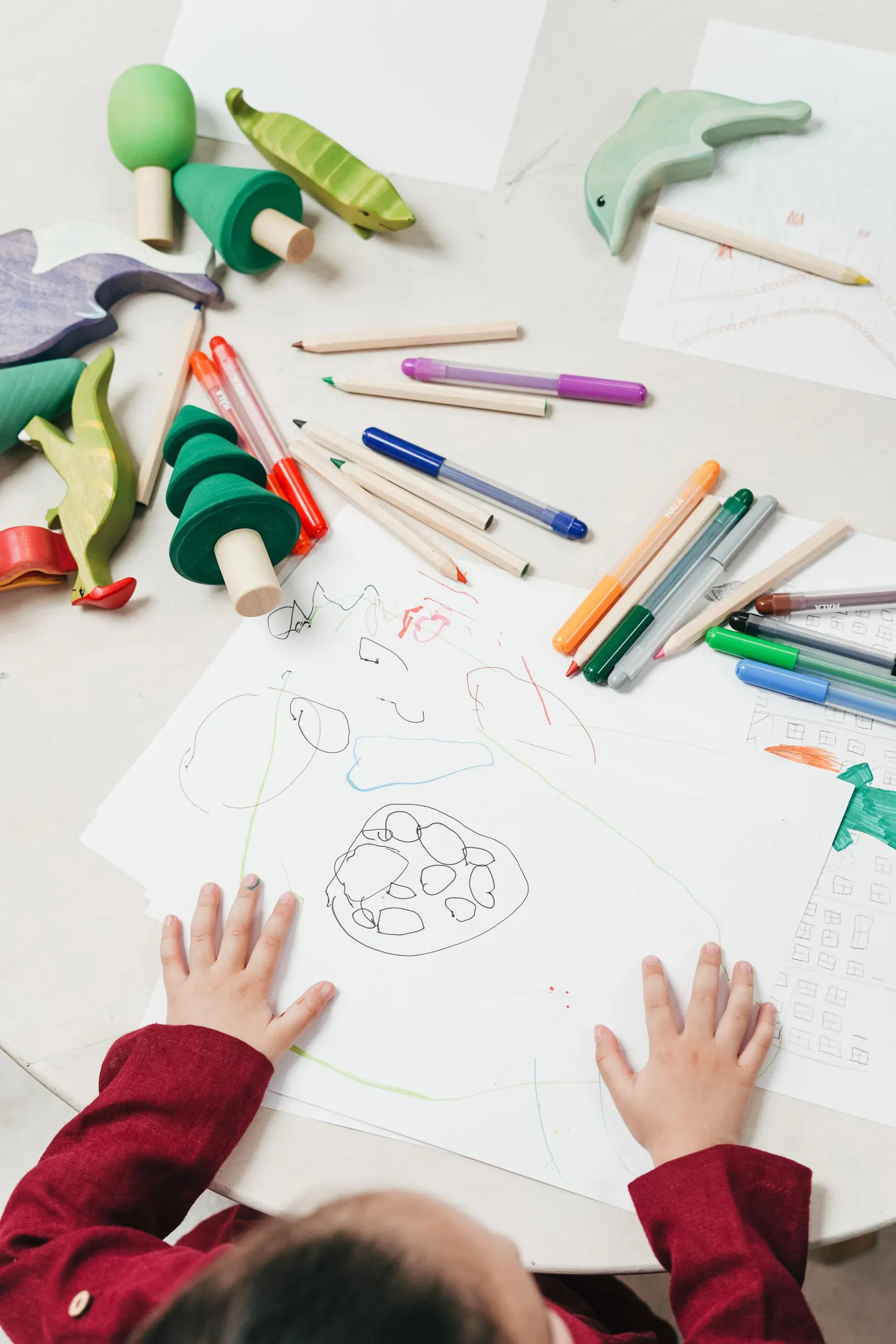
You're clearing the kitchen table and find it. A drawing of a monster with sharp teeth. Or a house on fire. Or a whole page coloured in with black marker, pressed so hard the paper ripped.
Your stomach drops a little. Is something wrong? Is my child okay? Should I say something?
This happens to a lot of parents, especially around Halloween, when ghosts, skeletons, and zombies take over every page. The good news is that most dark or scary drawings are a normal, healthy part of growing up. But drawings can also be a way into a conversation your child doesn't have words for yet.
Here's what art therapists actually pay attention to, what the research says about "reading" kids' drawings, what to say when a picture worries you, and when it's worth getting a professional's eyes on it.
Is it normal for kids to draw scary things?
Yes. Very often, it's not just normal but helpful.
Kids draw what's on their minds, and a lot of what's on a child's mind is big and scary. Drawing a fear on paper gives them something they don't get in real life: control. The monster is only as big as the page. They decide whether it wins. They can scribble it out, add a cage, or give it a silly hat.
What's typical changes with age:
- Ages 3 to 5: Monsters, the dark, bad guys, getting lost. Young kids are just learning the difference between real and pretend, so fears feel very real. Drawing them is one way they work it out.
- Ages 6 to 9: Battles, explosions, good guys vs. bad guys, injuries, sometimes a lot of red. Kids this age are thinking about rules, fairness, and power. Video games, movies, and what they hear at recess show up on the page.
- Ages 10 to 12: More detail and more drama. Skulls, weapons, villains, disasters. Many kids at this age copy styles from comics, anime, and games.
- Teens: Dark themes are often part of identity and style. A sketchbook full of skulls, shadows, or sad faces can be art, music taste, and self-expression all at once. That's different from a teen who is using art to say they're not okay, and we'll cover how to tell the difference below.
Kids also draw to make sense of real events. After a scary news story, a grandparent's death, a fire drill, or a big storm, it's common to see those themes in their art for a while. That's often a sign they're processing, not a sign they're stuck.
The myth of the drawing decoder ring
If you search online for what children's drawings mean, you'll find long lists of "hidden meanings." Black crayon means depression. No hands means guilt. A house with no door means a child feels shut out. Big eyes mean paranoia.
It sounds convincing. The problem is that it doesn't hold up.
In 2012, researchers reviewed the controlled studies on using drawings to tell whether a child had been sexually or physically abused. Their conclusion: no drawing sign or scoring system had enough evidence to support using it to identify abuse. Findings that did show up were rarely repeated, and many studies had serious flaws.[1]
Why does this matter for parents? Because the decoder ring approach can go wrong in both directions:
- False alarms. A child who loves their black gel pen gets labelled as depressed. A parent panics over a missing door.
- False reassurance. A child who draws happy rainbows can still be struggling. Bright drawings don't mean everything is fine.
Art therapists don't interpret drawings like a dictionary. A single picture, on its own, tells you very little. What tells you something is the child: what they say about it, how they act while making it, and whether it fits with everything else you're seeing.
Five questions to ask instead
When a drawing catches your attention, put the "what does this symbol mean" question aside. Ask yourself these instead.
1. What's the story?
What does your child say the drawing is about? A pile of bodies might be "the zombies from my game." A crying figure might be "the dog when it got lost." You won't know until you ask, and their answer matters more than anything on the page.
2. Is it a pattern?
One scary drawing is a moment. The same frightening figure, scene, or theme showing up over and over for weeks is worth noticing, especially if your child seems upset while drawing it.
3. Is it a change?
Compare it to what's normal for your child. A kid who has always drawn epic battles is just being themselves. A kid who suddenly switches from colourful animals to dark, violent, or chaotic scenes is showing you something has shifted.
4. What's the context?
What's going on in their life right now? A new sibling, a move, a separation, a loss, trouble with friends, a scary movie at a sleepover, a new game. Most dark drawings make complete sense once you know the context.
5. How is your child doing overall?
This is the big one. A child who draws monsters but is sleeping, eating, playing, and laughing as usual is probably fine. A child who draws monsters and is also having nightmares, clinging, melting down, pulling away, or saying worrying things needs more attention. The drawing is one clue alongside everything else.
Usually normal vs. worth a closer look
| Usually normal | Worth a closer look |
|---|---|
| Monsters, ghosts, and skeletons, especially in October | The same frightening figure drawn again and again, with your child seeming scared or upset while drawing it |
| Battle scenes, explosions, or blood after playing a game or watching a movie | Drawings of hurting a specific real person, a pet, or themselves |
| Using mostly black or dark colours for a while | Dark drawings plus changes in sleep, appetite, mood, or friendships |
| Drawing a real sad or scary event (a funeral, a storm, an accident) for a few weeks after it happens | Drawings about a past event that keep going for months and seem to upset your child more over time |
| Dark, moody, or "edgy" art in a teen's sketchbook | Words or images in a teen's art about wanting to die, disappear, or not exist |
| Curiosity about bodies at an age-appropriate level | Sexual content that seems beyond what your child should know for their age |
| Scribbling out or ripping up a drawing they didn't like | Destroying drawings in distress, hiding them, or becoming very upset if someone sees them |
Something in the right column is not proof of anything. It's a reason to slow down, get curious, and consider talking to a professional.
What if my child only uses black?
This is one of the most common things parents search for, so it gets its own section.
Kids choose black for all kinds of everyday reasons:
- It's the marker that works best, or the only one with a cap
- It makes the strongest, clearest lines
- They're copying comics, manga, or a style they like
- It's their favourite colour this month
- They're drawing at night, in space, in a cave, or in a story that just happens to be dark
On its own, a preference for black means very little. The same five questions apply. Is your child otherwise okay? Has anything changed? What do they say about their drawings? If dark colours come along with a dip in mood, energy, or interest in things they used to enjoy, that combination is worth paying attention to. The colour is not the concern. The overall picture is.
What to say when a drawing worries you
Your reaction in the first few seconds matters more than anything else. If your child sees shock, fear, or disgust, they learn that this topic is off-limits. That's the opposite of what you want.
Try these:
- "Tell me about your drawing."
- "What's happening in this part?"
- "Who's this? What are they feeling?"
- "What happens next in the story?"
- "If you could add something to this picture, what would it be?"
- "I'd love to hear about it whenever you feel like telling me."
Avoid these:
- "Why would you draw something like that?"
- "That's creepy" or "That's disgusting"
- Telling them what it means: "Are you sad? Is this about Daddy?"
- Banning scary drawings
- Bringing it to a teacher or relative in front of your child
Notice that the helpful questions are open and curious. They invite your child to lead. If your child says, "It's just a monster," that's a fine answer. You've shown them it's safe to bring hard things to you, and that matters for the next time.
If you already reacted strongly, that's okay. Go back later and repair it: "Earlier I was surprised by your drawing and I said something that wasn't very kind. I'm sorry. I'd really like to hear about it if you want to tell me."
If your child usually goes quiet rather than melting down when things are hard, drawing can be a gentler way in. Our article on kids who shut down instead of melting down has more ideas.
Can drawings show abuse or trauma?
This is the question behind a lot of parents' worry, so here's what the research says.
A drawing cannot tell you whether a child has been abused. As the research above shows, there's no reliable "sign" in a drawing that proves or rules out abuse.[1]
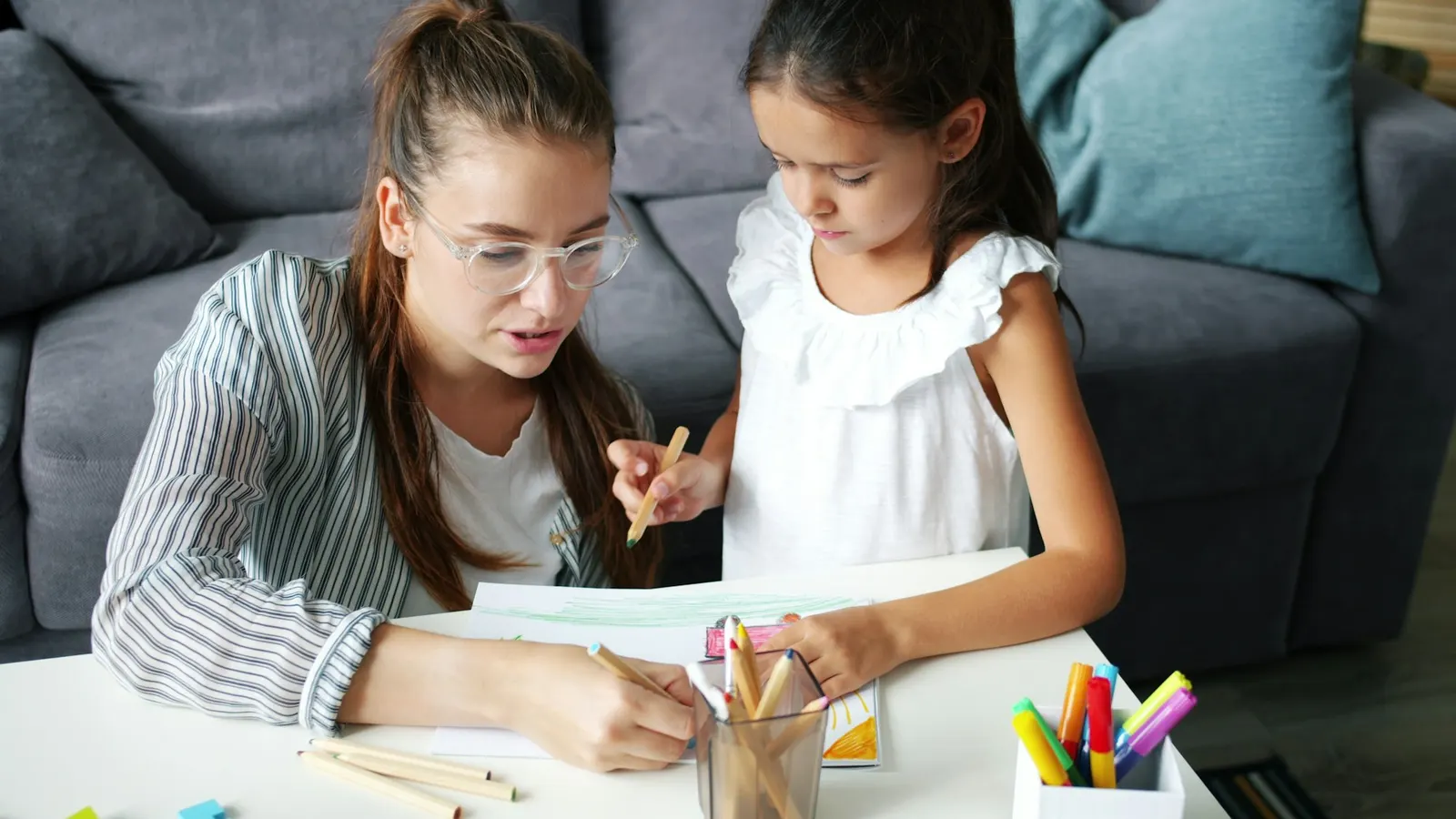
But drawing can help children talk. In one study of children aged 5 to 12 during real mental health assessments, kids who were invited to draw while they talked shared twice as much information as kids who only talked.[2] For many children, it's easier to say something hard when their hands are busy and they're looking at paper instead of an adult's face.
So if a drawing worries you, think of it as an open door to a conversation, not as evidence.
If your child tells you that someone has hurt them:
- Stay as calm as you can. Your calm tells them they did the right thing by telling you.
- Believe them, and tell them you're glad they told you.
- Don't press for details or ask leading questions. Let trained professionals do the interviewing.
- Write down what they said, in their words, as soon as you can.
- In Ontario, anyone with reasonable grounds to suspect a child is being harmed should report it to a children's aid society. In York Region, that's York Region Children's Aid Society. Call 911 if a child is in immediate danger.
If you're worried about your child's safety right now:
- Call 911 if anyone is in immediate danger
- Kids and teens can call Kids Help Phone at 1-800-668-6868 or text CONNECT to 686868 (24/7, free and confidential)[4]
- Contact York Region Children's Aid Society if you suspect a child is being harmed
How art therapists actually use drawings
So if art therapists don't decode drawings, what do they do with them?
In art therapy, the drawing is not a test. It's a tool for expressing, processing, and talking about things that are hard to say out loud. Here's what that looks like in a session:
- The child leads. The therapist asks about the image ("Tell me about this part") rather than telling the child what it means.
- The picture creates distance. It's easier to talk about "the worry monster" than to say "I'm scared all the time." Putting a feeling on paper lets a child look at it from the outside, change it, and feel more in control of it.
- Making art calms the body. The repetitive, hands-on process of drawing, painting, or building can help a child's nervous system settle enough to think and talk.
- Change happens on the page. A child might draw a scary memory, then draw what would have helped, then draw a safe place. Over time, the drawings often shift as the child does.
Art therapists also use structured activities depending on the child's needs. Younger kids might draw "where the worry lives in my body" or a comic strip of a hard day with a new ending. Teens might create a mask that shows the face they show the world on the outside and what they feel inside.
Does it work? A 2020 review of 37 studies on art therapy for children and teens with emotional, behavioural, and social difficulties found significant positive effects across a range of approaches and materials.[3] Art therapy is especially helpful for kids who find talk therapy hard: younger children, kids who shut down, kids with anxiety or trauma, and teens who would rather do anything than "talk about their feelings."
At Young Sprouts Therapy, art therapy is offered by therapists including Nadine, our art therapist, and it's often combined with approaches like CBT, play-based work, and parent support. Art therapy can be part of support for anxiety, trauma, grief, and big feelings that are hard to put into words.
You don't need to be "artistic" to benefit. There's no grading and no right way to do it. The point is the process, not the product.
When to talk to a professional
Consider booking a consultation if:
- The same disturbing theme keeps showing up for several weeks, and your child seems upset by it
- Your child's drawings changed suddenly, along with changes in mood, sleep, appetite, or behaviour
- Your child drew or said something about hurting themselves or someone else
- Your child has been through something hard (a loss, a separation, a frightening event) and seems stuck
- Your child has trouble talking about feelings and you think a creative approach might help
- Your gut is telling you something is off
You don't need to bring a drawing to a first appointment, although it's fine if you'd like to. A therapist will want to understand your child as a whole, not just their artwork.
Frequently asked questions
Is it normal for kids to draw scary or violent pictures?
Yes. Monsters, battles, and scary scenes are a common and healthy way for children to explore fear, power, and big feelings. It's more worth noticing when the same disturbing theme repeats over time, comes with distress, or appears alongside changes in mood or behaviour.
What does it mean when a child only draws in black?
Usually not much. Kids pick black because it's their favourite, it makes clear lines, or it's the marker that works. It's only worth paying attention to if dark colours come with other changes, like low mood, withdrawal, or losing interest in things they enjoy.
Can a child's drawing show signs of abuse?
No drawing sign has been shown to reliably identify abuse. However, drawing can help children talk about hard experiences. If your child tells you someone has hurt them, stay calm, believe them, and contact a children's aid society or police.
What do art therapists look for in children's drawings?
Art therapists focus less on symbols and more on the child: the story they tell about the drawing, how they act while making it, patterns over time, and how the art changes as therapy goes on.
How should I react if my child draws something disturbing?
Stay calm and curious. Say "Tell me about your drawing" instead of "Why would you draw that?" Let your child lead, and avoid telling them what you think it means.
How is art therapy different from an art class?
An art class teaches skills and focuses on the finished product. Art therapy is mental health treatment provided by a trained therapist. It uses the creative process to help children express and work through feelings, and there's no right or wrong way to make the art.
Does Young Sprouts offer art therapy for kids and teens?
Yes. We offer art therapy for children and teens at our Thornhill office, serving families in Vaughan, Richmond Hill, Markham, and North York, as well as online across Ontario.
Your child's drawings are an invitation
Most of the time, a scary drawing is just a kid being a kid. But every drawing is also an invitation. When you meet it with curiosity instead of alarm, you teach your child that they can bring you anything, even the dark stuff.
If something about your child's art, mood, or behaviour is sitting with you, we're here to help you sort it out.
Book a free 15-minute consultation or learn more about art therapy for kids and teens in Vaughan and Thornhill.
For more creative ideas at home, see Creative Calm: At-Home Art Activities to Support Your Child's Mental Health.
References
- Allen B, Tussey C. Can projective drawings detect if a child experienced sexual or physical abuse? A systematic review of the controlled research. Trauma, Violence, and Abuse. 2012;13(2):97-111. https://pure.psu.edu/en/publications/can-projective-drawings-detect-if-a-child-experienced-sexual-or-p/
- Woolford J, Patterson T, Macleod E, Hobbs L, Hayne H. Drawing helps children to talk about their presenting problems during a mental health assessment. Clinical Child Psychology and Psychiatry. 2015;20(1). https://www.academia.edu/22460531/Drawing_helps_children_to_talk_about_their_presenting_problems_during_a_mental_health_assessment
- Bosgraaf L, Spreen M, Pattiselanno K, van Hooren S. Art therapy for psychosocial problems in children and adolescents: a systematic narrative review on art therapeutic means and forms of expression, therapist behavior, and supposed mechanisms of change. Frontiers in Psychology. 2020;11:584685. https://www.frontiersin.org/journals/psychology/articles/10.3389/fpsyg.2020.584685/full
- Kids Help Phone. https://kidshelpphone.ca/
This article is for general information and is not a substitute for professional assessment or advice.