Why Your Autistic Child Can Sing But Not Talk (And How to Turn Songs Into Words)
By Young Sprouts Therapy
· 18 min read
By Young Sprouts Therapy
If your autistic child can sing but not talk, it is because singing and speaking do not rely on exactly the same brain systems. Sung words are slower, more predictable, and carry no real-time social pressure, so they stay accessible for many children when ordinary speech does not. Your child is not withholding words. They are using the route that is open.
That distinction matters, because it changes what you do next. The singing is not a detour away from language. For a lot of children, it is the most promising material you have to work with.
| Different brain routes | Singing and speaking use overlapping but different brain networks, which is why one can be fluent while the other is not. |
| Whole chunks of language | Sung and echoed phrases draw on memory for whole chunks of language rather than on building sentences word by word. |
| Humming is regulation | Constant humming is usually regulation, not a habit to break, and suppressing it tends to backfire. |
| Songs can become words | Songs can be gradually reshaped into spoken words using a slow, structured sequence rather than by asking your child to "use your words." |
| Alongside speech therapy | Music-based support works alongside speech-language therapy, never instead of it. |
Spoken conversation asks a great deal of a child in a very short window. It depends on fast, sequential motor planning, retrieving the right word, organizing the sounds in order, and producing them at conversational speed while also tracking the other person's face, tone and turn. Singing a familiar song asks for almost none of that. The words are already fixed. The timing is already set. Nobody is waiting for an improvised reply.
Singing also recruits a broader network across both hemispheres, including regions that handle melody, pitch contour and rhythm. That gives your child something spoken language does not offer: extra scaffolding. A tune supplies a predictable shape, a steady beat, and a known sequence of words, so there is far less to generate from scratch.
None of this reflects intelligence, effort or willingness. A child who sings beautifully and cannot ask for juice is not choosing the easy option. They are showing you which route is currently passable, and which one needs building.
| Feature | Spoken conversation | Singing a familiar song | What this means at home |
|---|---|---|---|
| Pace | Fast, set by the other person | Slower, set by the melody | Slow your own speech down and add rhythm before you add words |
| Predictability | Different every time | Identical every time | New words land more easily inside a tune your child already knows |
| Social pressure | High, with eye contact and turn-taking | Low, self-paced and repeatable | Drop the demand to look at you while practising |
| Motor planning | Must be organized on the spot | Already rehearsed and stored | Reuse the same phrase daily rather than rotating through many |
| Built-in support | None | Melody, beat and fixed lyrics | If your child freezes at a question, embed the same words in a song |
| Repeatability | Rarely repeated exactly | Can be repeated endlessly without frustration | Repetition here is practice, not stalling |
On its own, no. Plenty of non-autistic toddlers hum tunes and chant nursery rhymes before they string sentences together. Singing early is not a red flag, and this article cannot tell you whether your child is autistic. Only a qualified assessor can do that.
What matters far more than the singing is everything around it. Does your child have any dependable way to ask, refuse, protest and point you towards what they want? That might be spoken words, but it might equally be gesture, pointing, leading you by the hand, sign, picture exchange, or a communication device. A two-year-old who sings the alphabet and also points at the fridge and tries new sounds is on a different footing from a four-year-old who can perform entire scripts from a show but has no reliable way to say "help."
Flexibility is the other thing to watch. A child who sings the same three lines in the same tone in the same situation every single time is doing something closer to storing and replaying than to playing with language. A child who starts swapping words in and out of a tune is experimenting, and that is the signal worth paying attention to.
Echolalia is the repetition of language your child has heard before, whether that is a phrase from a parent, a line from a video, or an entire song. Sung scripts and echoed phrases share a lot of underlying machinery. Both draw on memory for whole intact chunks rather than on assembling a sentence one word at a time.
This is not a defect, and it is not empty repetition. For many children it is a genuine developmental route into language, and it has a recognisable shape.
Some speech-language pathologists describe this route in four broad stages:
The practical implication is the important part. The goal is not to stop your child using scripts. It is to help the chunks break down into smaller pieces they can recombine.
One honest caveat: gestalt language processing is a descriptive clinical framework rather than a settled body of evidence, and clinicians differ in how much weight they give it. You may hear different views from different professionals, and both can be offered in good faith.
| What you notice | What it usually means | What to do | What not to do |
|---|---|---|---|
| Same song, same tone, same situation every time | Stored script or self-soothing | Note when and where it happens | Interrupt or correct it |
| Child pauses mid-song and looks at you | Early intentional communication | Fill in the word, then pause again | Rush in and finish the whole line |
| Child swaps a new word into a familiar tune | Flexible, generative language | Repeat it back warmly and immediately | Move straight on to a harder target |
| Child sings the swing song while pointing at the swing | A real request, made through song | Respond to the request as a request | Insist on spoken words first |
| Singing rises in loud rooms, drops when calm | Regulation | Treat it as a coping tool and reduce the load | Try to stop the singing |
Near-constant humming or singing is usually vocal stimming, and it tends to serve one of two purposes. It regulates, giving your child a predictable sound to hold onto when a room is too loud or too bright or too fast. Or it provides input, filling a quiet moment with something satisfying.
Trying to switch it off rarely goes well. Suppression often raises anxiety, and the need usually reappears somewhere else, sometimes in a form that serves your child less well.
There is a more useful move available. For one week, keep a rough note of three things: what was happening in the minute before the humming started, what the environment was like, and what happened straight after. Patterns surface quickly. Humming that spikes in the supermarket and settles in the car is doing regulation work. Humming that fills quiet, unstructured time is more likely sensory seeking. Humming that stops the moment you make eye contact may be an opening bid for connection.
That record is worth keeping. It is precisely the kind of concrete detail a clinician can act on at a first appointment, and it is far more useful than trying to recall it all from memory months later.
If the humming is mostly doing regulation work, and especially if you are also dealing with sensory overload and meltdowns, that is a separate piece of the puzzle. We have written a companion guide on using music for regulation before, during and after a meltdown.
This sequence moves from where your child already is towards spoken words. Work through it slowly. Each rung should feel easy before you go up.

What you do: Sing your child's song with them, at their pace, adding nothing new.
What it sounds like: Just the song, exactly as they do it.
Success looks like: They let you in. They may glance at you, move closer, or get louder.
Common mistake: Turning it into a lesson on day one.
What you do: Sing up to a highly predictable word, then stop and wait with a warm, expectant face. Count to five in your head.
What it sounds like: "Twinkle twinkle little ..." then silence.
Success looks like: Any vocal attempt at all. A grunt, a vowel, a half-word all count.
Common mistake: Filling the silence too fast. Most children need longer than feels comfortable.
What you do: Put a real-life word into the familiar melody.
What it sounds like: Singing "more bubbles, more bubbles" to a tune they already know.
Success looks like: They sing the new word back, even approximately.
Common mistake: Changing several words at once, which removes the scaffolding.
What you do: Move gradually from sung, to chanted on a single note with the rhythm intact, to spoken with exaggerated rhythm, to ordinary speech.
What it sounds like: "More bubbles" sung, then chanted, then said with a bounce, then said plainly.
Success looks like: The word survives each step down.
Common mistake: Doing all four steps in one session. This happens over weeks.
What you do: Use the target word at the actual moment it is needed, at the bubble jar, the snack cupboard, the bottom of the slide.
What it sounds like: You hold the bubbles, pause, and give the word its shape.
Success looks like: Your child uses the word to make something happen.
Common mistake: Withholding the thing your child needs to force a word. Never do this. Respond to the request however it arrives, then model the word.

What you do: Repeat with a different person, in a different room, at a different time of day.
What it sounds like: The same word at Grandma's house, at bath time, at the park.
Success looks like: The word is no longer locked to one setting.
Common mistake: Skipping this rung and wondering why the word never shows up at school.
A few notes on dosage. Two or three minutes woven into things you already do beats one long practice session, every time. Stay on a rung until it is genuinely easy. If your child stalls, drop back a rung without any comment or fuss. And celebrate the attempt rather than the accuracy, because attempts are what multiply.
Tracking turns a vague worry into something you can act on. It also catches small gains that are almost impossible to notice in the middle of an ordinary week, and it gives any clinician you eventually see a real picture instead of a summary from memory.
| Date | Song or script | Rung | What your child did | Spoken attempt? | Notes |
|---|---|---|---|---|---|
| 12 Mar | Bubble song | 2 | Waited, then said "buh" at the gap | Yes | Late afternoon, quiet room, after snack |
After two weeks, read it for pattern rather than for progress. Which songs work. Which times of day work. Whether attempts are becoming more frequent, more varied, or more flexible, because flexibility matters more than precision at this stage. A single new word slotted into an old tune tells you more than ten perfect repetitions of the same line.
The strongest single piece of evidence here comes from Canada. In a randomised controlled trial run in Montreal, 51 autistic children aged 6 to 12 were assigned to either eight to twelve weeks of improvisational music sessions using song and rhythm, or to a carefully matched non-music intervention. The music group showed improvements in parent-reported social communication, alongside changes in resting-state connectivity between auditory and motor regions of the brain. It remains one of the few studies to pair a behavioural result with a neurological one.
Clinically, this is not new territory. Music has been used both to assess and to support communication in autistic children for decades, and reviews of that clinical work describe music as a way in when spoken language is not yet available. Further indexed research on music-based approaches in autism is also available through PubMed.
Now the limitations, which deserve their own paragraph. Many trials in this field are small. What counts as "music therapy" varies enormously between studies, which makes results hard to pool. Most importantly, the evidence is considerably stronger for social communication, engagement and shared attention than it is for spoken language specifically. Outcomes vary widely between children, and nobody can tell you in advance which group your child will fall into.
You may come across AMMT, an approach that pairs intoned phrases with rhythmic tapping. It appears in the research literature with some encouraging early results, but it is a specialized research protocol rather than a service families can typically book at a community clinic. If a provider markets it as a standard offering, ask them directly where they trained in it.
One line worth holding onto through all of this: music-based support works alongside speech-language therapy, not instead of it.
For a minimally speaking child, a first session is quieter and less structured than most parents expect.
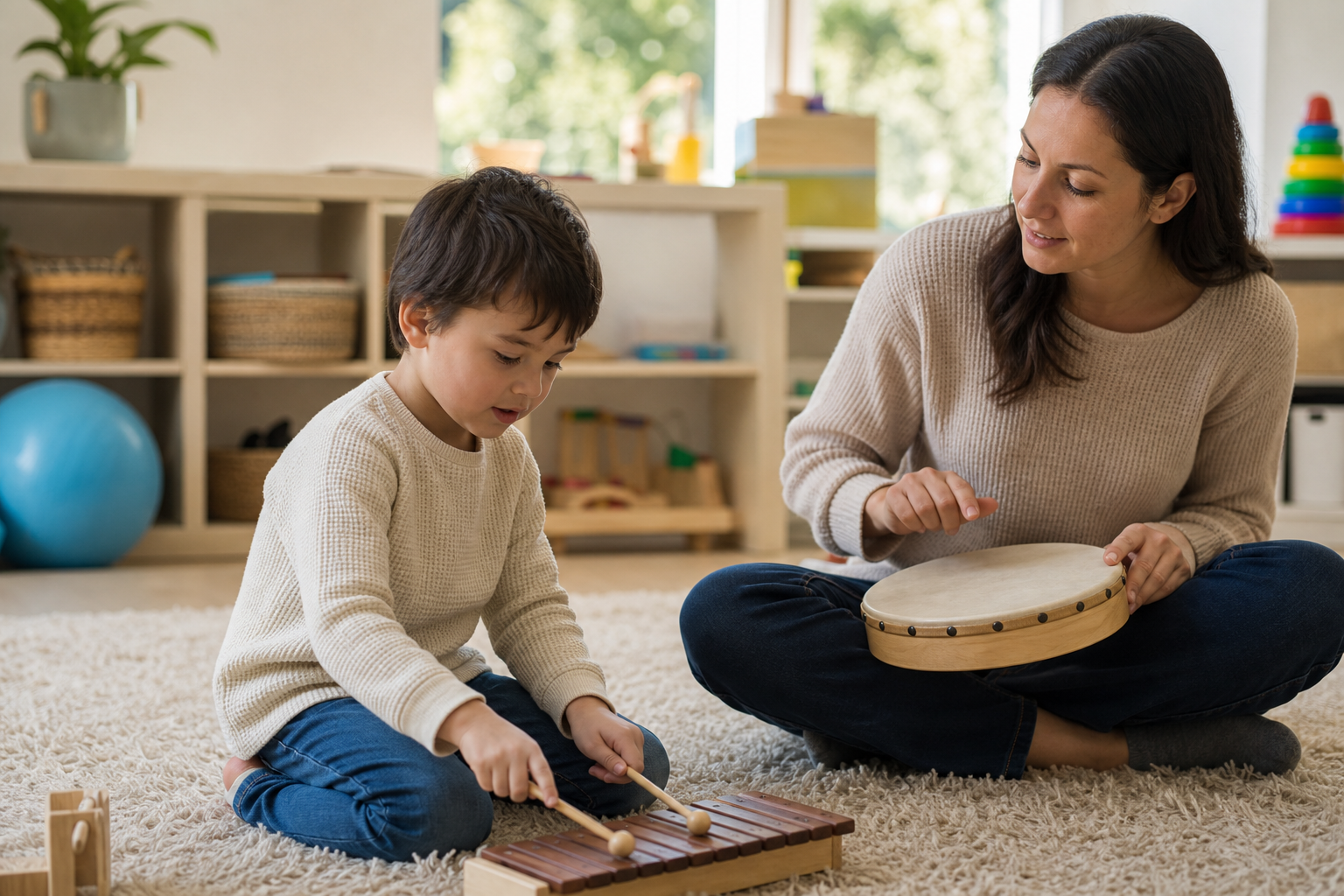
It usually opens with a hello song, sung the same way every week, which becomes the anchor your child comes to recognize. From there the therapist follows your child's lead rather than running a curriculum. If your child bangs a drum, the therapist plays with that rhythm. If your child hums, the therapist hums back and gently varies it. The point is to meet what your child is already doing and turn it into something shared.
Instruments get offered as low-pressure choices, because choosing is itself communication. Then come the pauses, which are deliberate and often longer than feels natural, because a pause is an invitation to take a turn. A goodbye song closes the session and supports the transition out.
What the therapist is watching for is not musical skill. It is shared attention, initiation, turn-taking, vocal attempts, and how your child manages a new person in a new room. Caregivers are part of this, and you should leave with one specific thing to try at home. You can read more about how we approach music psychotherapy for children and teens and how it fits alongside autism therapy for kids and teens.
This is the part most articles skip, and it is the part that actually determines what happens next for your family.
The pathway looks simple on paper. You register with the Ontario Autism Program, AccessOAP handles intake, and children are invited into Core Clinical Services in the order they registered. In practice, many Ontario families wait years between registering and being invited. That gap is why generic advice like "see a speech-language pathologist" can feel almost insulting to a parent who registered two years ago and has heard nothing since.
A note on eligibility, because there is a lot of confusion here. The province defines which services can be purchased with Core Clinical Services funding, and that list is set by the ministry rather than by clinics. Before you purchase anything, confirm directly with your AccessOAP care coordinator what is eligible for your child. Do not rely on a provider's marketing, including ours.
Start several of these at once. They do not need to happen in sequence.
"Music therapist" is not the same as "music teacher," and the difference is worth knowing before you pay anyone.
In Canada, the recognized credential is MTA, Music Therapist Accredited, granted through the Canadian Association of Music Therapists. MT-BC is the equivalent American board certification. Separately, a music therapist who is registered with the College of Registered Psychotherapists of Ontario is regulated as a psychotherapist, which matters both for accountability and because many extended health plans cover registered psychotherapy.
Ask three direct questions: what is your credential, which college or association are you registered with, and can I verify that registration. Any good clinician will answer without hesitation. You can see the credentials of our accredited music therapist and registered psychotherapist on our team page.
Certain patterns mean it is worth getting an assessment rather than waiting to see what develops.
Talk to a professional if you notice:
The Canadian pathway generally runs from your family doctor or paediatrician, to a developmental paediatrician or a speech-language pathologist registered with CASLPO, and through your school board once your child is enrolled. You do not have to complete one step before starting the next. Given current wait times, running them in parallel is usually the sensible choice.
We work with children, teens and families from our office on Centre Street in Thornhill, and with families across Vaughan, Richmond Hill, Markham and North York, plus virtual sessions across Ontario.
Our approach is play-based, relationship-first and built around caregiver involvement, because the work that matters most happens between sessions. Music psychotherapy at Young Sprouts is delivered by an accredited music therapist who is also a registered psychotherapist. And because a diagnosis affects the whole household, we also support brothers and sisters, something we have written about in our guide to siblings of autistic children.
If you would like to talk it through with someone, you can book a free 15-minute consultation. No pressure, and no expectation that you have it all figured out first. Most parents do not.
Singing and speaking rely on overlapping but different brain systems. Sung words come with a fixed melody, a steady rhythm and no real-time social pressure, so they stay accessible when the fast, on-the-spot planning required for conversation does not. Your child is using the route that is currently open to them.
Not by itself. Many non-autistic children hum and chant before they speak in sentences. What matters more is whether your child has a reliable way to request, refuse and direct your attention, whether through words, gesture, sign, pictures or a device. Only a qualified assessor can determine whether autism is present.
Music-based approaches have reasonable evidence for improving social communication, engagement and shared attention, and weaker but promising evidence for vocal output. Results vary considerably between children. Music therapy should sit alongside speech-language therapy rather than replace it, and no ethical provider will guarantee speech.
Constant humming is usually vocal stimming that helps with regulation, provides satisfying sensory input, or both. It often increases in busy or overwhelming environments. It is generally better to reduce the demands around your child than to try to stop the humming itself.
No. Suppressing the singing removes the most accessible communication your child currently has, and it tends to increase distress rather than prompt speech. The more productive approach is to build spoken words gradually out of the songs your child already uses.
Musical echolalia is the repetition of songs or sung phrases heard elsewhere, reproduced as whole intact chunks rather than assembled word by word. It draws on the same memory processes as other forms of echolalia and is a recognized route into language for many children.
No. Music therapy is not music lessons and requires no musical ability, training or interest in performing. The therapist works with whatever sounds, rhythms and preferences your child brings, including banging, humming and vocalising.
Eligible expenses under Core Clinical Services are set by the province, so confirm what applies to your child directly with your AccessOAP care coordinator before purchasing any service. Separately, when music therapy is delivered by a registered psychotherapist, many extended health plans may cover it under psychotherapy. Check the details of your own plan.
Book a free 15-minute consultation with Young Sprouts Therapy. We'll help you make sense of what you're seeing and figure out a next step — in person in Thornhill/Vaughan or virtually across Ontario.
Book a Free Consultation →This article is for general information only. It is not a substitute for individual assessment, diagnosis or treatment, and it cannot tell you whether your child is autistic. If you have concerns about your child's communication or development, please speak with a qualified health professional. If your child may be in immediate danger, call or text 9-8-8 or call 911.